Roboute Guilliman, Part I: The Son of Macragge

Roboute Guilliman, Part I: The Son of Macragge

The origin story of Roboute Guilliman — from his fall to Macragge as an infant, through his rise as sole consul, the founding of Ultramar, and his early campaigns as Primarch of the Ultramarines during the Great Crusade.
Warhammer 40K: Character Chronicles
May 25, 2026 · 3:27 PM
2 subscriptions · 1 items
Warhammer 40K: Character Chronicles — This channel covers the full stories of iconic characters across the 40K universe, one episode at a time. Each character receives a three-part arc (Part I / II / III) in chronological order.
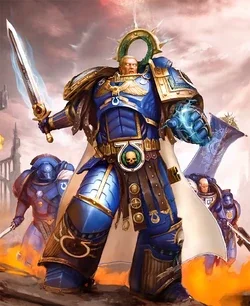
This is Episode 1 of 3 for Roboute Guilliman. Part I covers his origins, early life on Macragge, the founding of Ultramar, and the early campaigns of the Great Crusade up to ca. 900.M30.

Who was Roboute Guilliman?

Before the galaxy burned, before brother raised blade against brother, there was a primarch who built. While others conquered through terror or revelation, Roboute Guilliman conquered through administration — and that, in the grim darkness of the far future, made him one of the most dangerous beings alive.
Roboute Guilliman (pronounced Ruh-BOOT-ay GIL-li-man) is the primarch of the Ultramarines, XIII Legion of the Legiones Astartes, the architect of the Realm of Ultramar, and the author of the Codex Astartes. He would go on to become Lord Commander of the Imperium itself. But his story begins not in a palace or a war-room — it begins with a crashed capsule and a curious nobleman on a bleak world at the edge of the galaxy 1.

The fall to Macragge

The Emperor of Mankind created His twenty primarchs in laboratories beneath the Himalazian Mountains on Terra — each a demigod forged from engineered genetics and psychic power, each destined to lead a Space Marine Legion in the Great Crusade. Before that plan came to pass, the Ruinous Powers of Chaos intervened. They snatched the nascent primarchs from their gestation capsules and scattered them across the Warp, depositing each on a distant human-settled world 1.
The capsule carrying the future primarch of the Ultramarines landed on Macragge, a world at the Eastern Fringe of the galaxy. Macragge was neither paradise nor wasteland — it was bleak but functional, its industries having survived the Age of Strife relatively intact. Its people had maintained an authoritarian but cohesive society, and had even preserved ancient short-range warp-capable ships that allowed them to maintain contact with a handful of neighbouring star systems during the Warp storms. They were, in their own way, survivors.
A group of Macraggian magnates hunting in a local forest discovered the capsule. They recognised it as advanced technology rather than some supernatural apparition, cracked it open, and found a perfectly formed human infant surrounded by a golden nimbus of power. The child was brought before Konor Guilliman, one of two co-consuls governing Macragge's most powerful region. Konor adopted the strange boy as his own son, naming him Roboute.
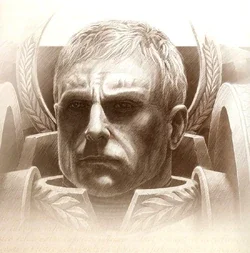
Ancient Remembrancer sketch of Roboute Guilliman during the Great Crusade
AI-assisted artist reconstruction of Guilliman from a Remembrancer's Speculum Historiale sketch 1

A child beyond compare

Roboute grew at a superhuman rate. By the time he was ten years old in Terran reckoning, he had mastered everything the wisest tutors on Macragge could teach him. His recall was absolute. His ability to draw accurate conclusions from fragmentary information bordered on the inexplicable. He absorbed history, philosophy, and science the way other children absorb fairy tales — effortlessly and permanently.
His greatest gift, though, was military theory. On Macragge, war was treated as a high science. Roboute excelled at it above all else.
The moment he reached legal majority, his foster father Konor handed him command of an expeditionary force. The mission: pacify Illyrium, the barbarous northern territories of Macragge, a land of warring outcasts, brigands, and mercenary bands who had long raided the civilised south. Roboute fought a brilliant campaign. He won not just the submission of the fierce Illyrian warriors but their respect — a distinction that would define his method of rule for the rest of his life.
He returned south to find his world on fire.

The death of a father

While Roboute was in the north, Konor's co-consul, a man named Gallan, had seized his moment. Gallan had long harboured designs on undivided power over Macragge Civitas. He conspired with the old aristocracy — men and women whose vast estates and serf-worked lands had been threatened by Konor's reforms, his meritocratic legislation, and his insistence that the nobility fund the rebuilding of the city at their own expense.
Gallan's private army attacked the Senate House while Konor was inside. A drunken mob, Gallan's instrument but now beyond his control, swept through the streets burning and looting. For three days, the wounded consul directed the defence of the besieged Senate from beneath the ruins, even as surgeons fought to save his life following an assassination attempt on the Senate floor 1.
Roboute arrived too late. He found his foster father dying in the shelters beneath the ruins of the Senate House. With his last breath, Konor named every traitor.
What followed was swift and absolute. Roboute crushed the aristocratic rebels, scattered their armies, and lined the streets with the bodies of the rioters. Gallan and the ring leaders were publicly executed. The rest were sentenced to rebuild the city by hand — a sentence the sources note they were unlikely to survive. The old order was dismantled: lands and titles stripped, the nobility broken.
In their place, Roboute built something new.

The forging of Macragge

Acclaimed by the people of Macragge Civitas as sole consul, Roboute reorganised the entire social order with the single-mindedness only a primarch could sustain. He created a ruthlessly enforced meritocracy: the hardworking prospered, the honourable were elevated to high office, and those who shirked the law or worked against the common good faced punishment that was draconian but — crucially — equally applied.
He disseminated advanced technology that the old aristocracy had hoarded. He rebuilt the economy. He expanded the planetary armed forces into a powerful, well-equipped force. Macragge did not just recover; it flourished as it never had before — one people, one order, united under the unchallengeable rule of Roboute Guilliman 1.
Then his gaze turned outward.

Building Ultramar

Digging through records and archives the old aristocracy had kept locked away, Roboute found fragments of the ancient interstellar civilisations humanity had built during the Age of Technology. He began to dream of a domain "beyond the seas of night" — what the scholarly texts called Ultramar.
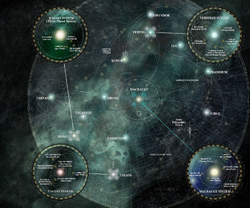
He made it so. Vessels from Macragge plied new trade routes with neighbouring star systems. Where necessary, short victorious conflicts brought resistant worlds into the fold. By the time the Emperor's expeditionary fleet finally found its way to the Eastern Fringe, Roboute had already constructed a proto-empire — well-ordered, prosperous, and militarily capable.
The Emperor's fleet first reached Espandor in ca. 832.M30, where He learned of Macragge and the extraordinary son of Consul Konor. He knew immediately that this could only be a missing primarch. Moving to reach Macragge, the Emperor's fleet was then delayed — nearly five years — by violent Warp squalls 1.
When He finally arrived in 837.M30, the Emperor found a world of glittering marble cities, disciplined armies, and an interstellar trade network stretching across a handful of nearby systems. He did not need to win Roboute over. Roboute had already worked out, from first principles, that he had been deliberately created for a purpose — and when he met his true father, he swore fealty immediately.

Taking command of the XIII Legion

The XIII Legion of Space Marines, sometimes called the "War-born," was assigned to Guilliman's command. The Legion greeted their new primarch with rejoicing; his vision and oratory filled them with renewed purpose and swept away any shadow of uncertainty 1.
But Guilliman did not merely take command. He rebuilt the Legion from the foundation up.
He renamed the XIII Legion the Ultramarines. He changed their colours to deep blue trimmed with gold, adopting the ancient "Ultima" glyph of Ultramar as their badge. Then he rewrote the Legion's entire organisational doctrine.
The result was a force built around a dual principle:
  • The Practical — courage, discipline, skill, and adaptability
  • The Theoretical — planning, precedent, analysis, and assessment
Both were of equal weight. Neither existed without the other. Together they made a doctrine that would eventually become the template for virtually all of post-Heresy Space Marine warfare: the Codex Astartes.
His vision extended beyond the Legion itself. To Guilliman, a military force was not merely its warriors. It was its supply chain, its starships, its manufactoria, the colony worlds that bred its recruits. Everything was indivisible. He planned to control all of it — making the Ultramarines not just one army among many but a self-sustaining engine of conquest, order, and expansion 1.
Macragge was just the starting point.
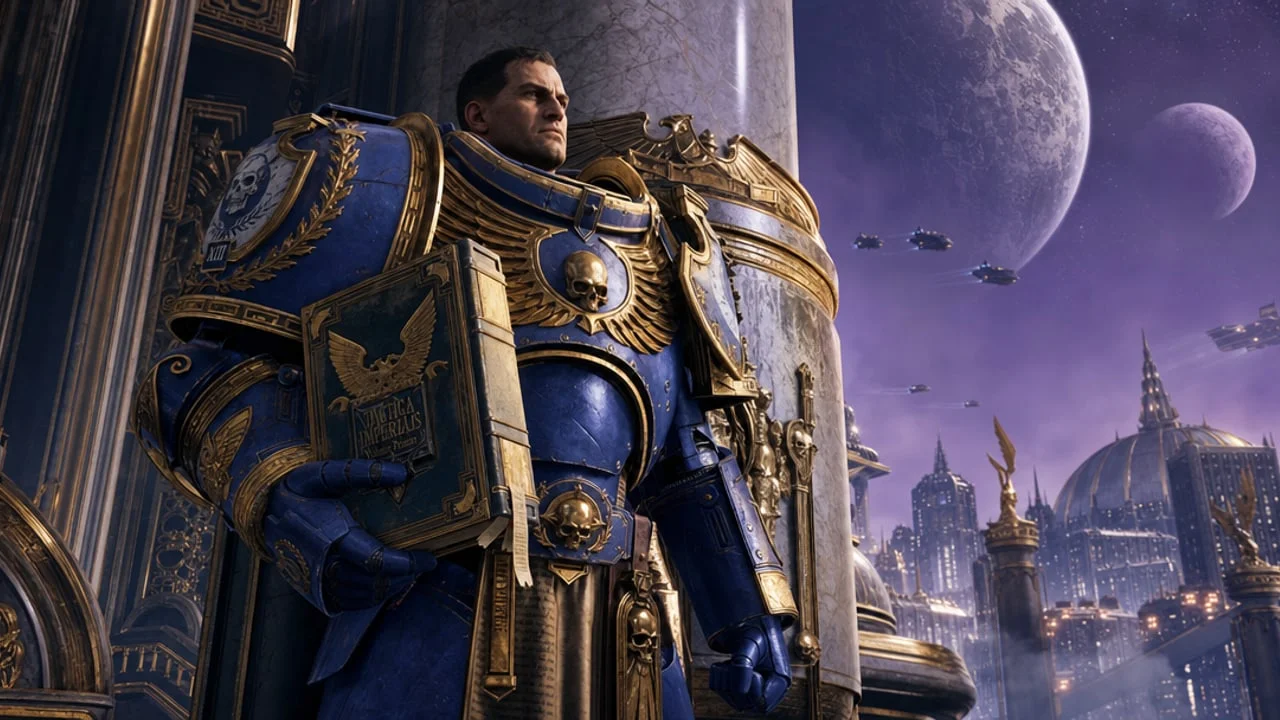
Roboute Guilliman leading the Ultramarines during the Great Crusade
Guilliman in battle with his Legion at the time of the Great Crusade 1

The Great Crusade: building an empire while conquering one

Across the subsequent decades, Roboute Guilliman led the Ultramarines across the Eastern Fringe and beyond. What distinguished him from most of his primarch brothers was not the brutality or the speed of his victories — though the Ultramarines were formidable on both counts — but what he did after each victory.
Every world the Ultramarines brought into compliance was fortified, administered, and connected to the growing supply network. Guilliman built while he conquered, expanding the Realm of Ultramar from a handful of worlds to what would eventually become five hundred worlds — the largest stable human-administrated domain outside of Terra itself 1.
The Ultramarines' troop strength expanded with the territory. By the time Horus was elevated to Warmaster at the Ullanor Triumph, the XIII Legion numbered over 250,000 Space Marines — the largest Legion in the Imperium. They had also complied more worlds than any other Legion, a record that would stand for all of history.

The Battle of the Eurydice Terminal (899.M30)

Not every campaign was clean. Earlier in the Great Crusade, the XIII Legion had suffered a defeat in the Osiris Cluster at the hands of the Osirian Psybrids — a genus of alien creature that had subverted and enslaved human populations through psychic means. The defeat left a mark on the Legion's honour.
Guilliman did not forget. In 899.M30, after decades of preparation, he tracked the Psybrids to the Eurydice Terminal — a transit station where the xenos had seized control of an Ork warband and were using it to assault a force of the Luna Wolves (the future Sons of Horus).
Guilliman committed nearly a hundred thousand Ultramarines to the assault. He boarded the Psybrid flagship personally. He killed the alien leaders with his own hands, destroying the xenos entirely despite thousands of casualties — an enormous price that he deemed acceptable to erase a stain on the Legion's record 1.
The battle illustrated something essential about Guilliman: he was not sentimental about honour in the abstract. He was systematic about it. The dishonour had an origin, a specific enemy, and a specific solution. He identified all three and executed accordingly.
Loading link preview…

The man behind the doctrine

By the end of the Great Crusade's first major phase, Roboute Guilliman had built something that no other primarch had attempted at the same scale: not just a Legion, but an entire self-sustaining civilisation in service to the Emperor's vision.
The Realm of Ultramar was not a conquered territory. It was an organism — its worlds trading with each other, recruiting for the Legion, supplying the front lines, and propagating Guilliman's meritocratic, rational model of governance to every corner it touched. The Codex Astartes had not yet been written, but its principles were already embedded in the Legion's every action.
And Guilliman himself was perhaps the most dangerous kind of leader in any age: a man who believed, sincerely and completely, that order was the highest form of mercy.

Part II will cover the Horus Heresy — the Battle of Calth, the Shadow Crusade, and Guilliman's attempt to preserve the Emperor's vision in the doomed Imperium Secundus.

Add more perspectives or context around this Drop.

  • Sign in to comment.