He rode in circles for 29 hours — and almost doubled the world record
On May 23, 1932, Australian cyclist Hubert "Oppy" Opperman set two back-to-back motor-paced world records at Melbourne's Motordrome — covering 860 miles (1,384 km) in 24 hours and 1,000 miles in 28h55m39s — nearly doubling the previous record of 528 miles, fuelled by yerba maté and coffee, drafted behind his manager's motorcycle on a fixed-gear bike with reversed forks, averaging 57.6 km/h for 29 straight hours on a 46-degree concrete bowl track.

On the evening of May 23, 1932, 27-year-old Hubert "Oppy" Opperman clicked into his pedals at Melbourne's Motordrome and started riding around a concrete bowl. He didn't stop for 29 hours. When he finally did, he had covered 860 miles (1,384 km) in 24 hours and 1,000 miles (1,609 km) in 28 hours 55 minutes 39 seconds — two motor-paced world records set back to back, in the same session, on the same bike. 1
The previous 24-hour motor-paced record, held by a man named John Lawson, stood at 528 miles and 925 yards. 2 Opperman beat it by 332 miles. That's not improving a record. That's dismantling it.
The machine that made it possible
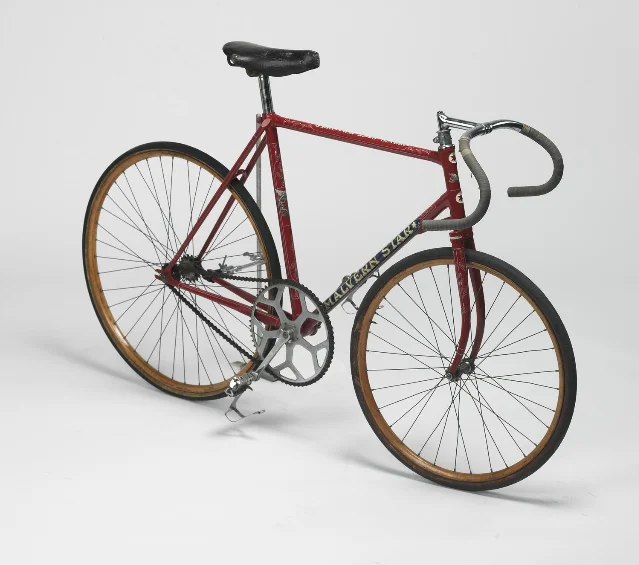
Opperman wasn't riding a normal bicycle. His Malvern Star "Pace Follower" — built specifically for the discipline of motor-pacing, where a cyclist tucks into the slipstream of a motorcycle — had a reversed front fork to shorten the wheelbase, a smaller 584mm front wheel, and a 64-tooth chainring paired to a 13-tooth rear sprocket. 3 That gear ratio is absurd even by modern standards. The bike had no freewheel — it was fixed gear, meaning Opperman's legs turned every single moment he was moving. For 29 hours.
The track itself added its own particular difficulty. The Melbourne Motordrome — built in 1924 on what is now the site of AAMI Park — was a concrete saucer 1/3 mile (536 metres) around, with banked turns pitched at 46 degrees. 4 Every lap was a fight against centrifugal force.
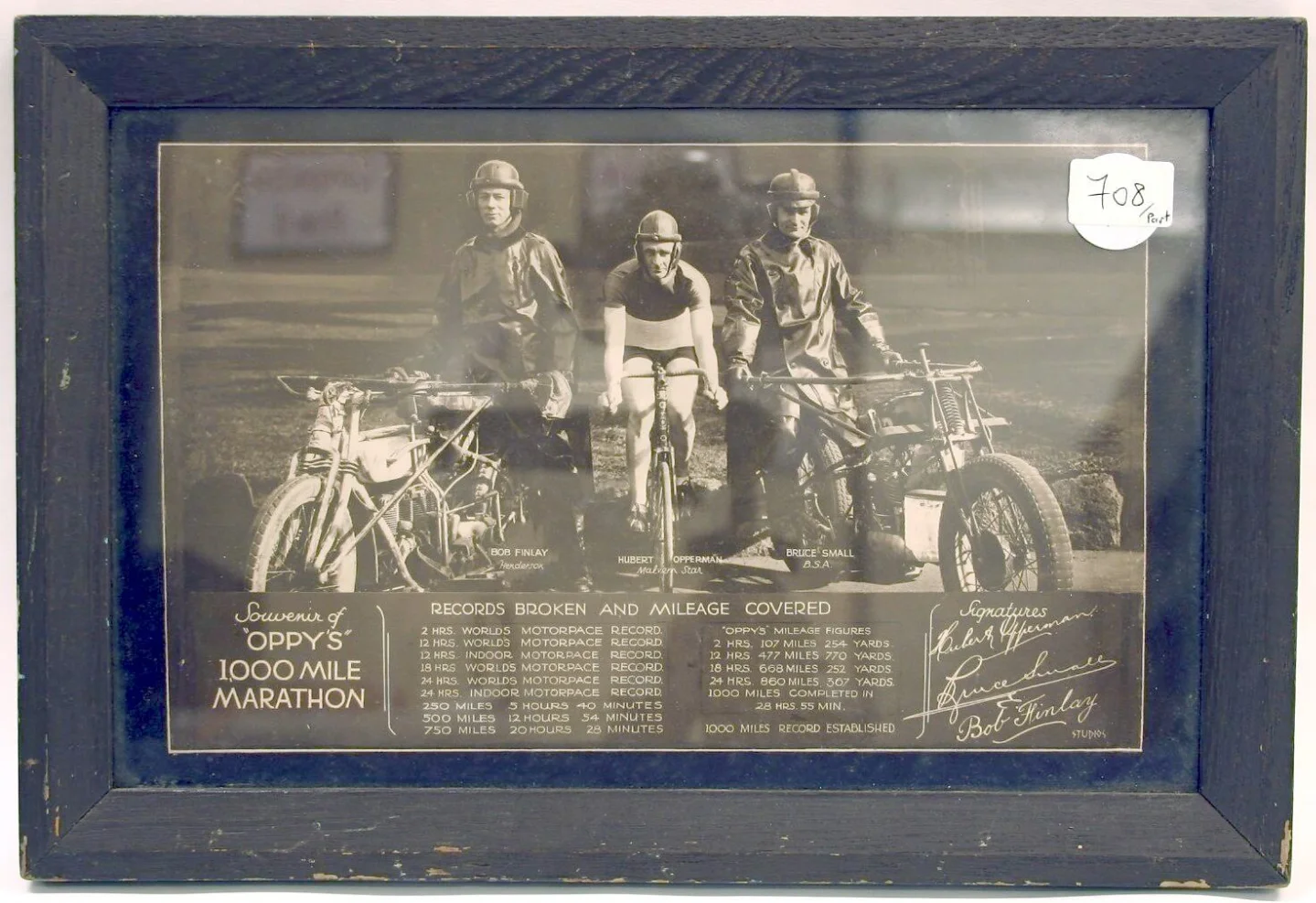
The two men pacing Opperman on motorcycles were Bob Finlay, a professional motor-pacer who drove a Henderson four-cylinder motorcycle, and Bruce Small, Opperman's own manager and the owner of Malvern Star bicycles. 5 Small had already persuaded Opperman into half his major record attempts. He was also the one who, when Opperman reached the 24-hour mark and considered stopping, talked him into keeping going until 1,000 miles. Opperman later said of Small: "He sold me on himself at a most opportune moment in my life." 6
Opperman averaged 57.6 km/h across those 24 hours — roughly the cruising speed of a Model A Ford — while following a motorcycle's rear wheel at a gap of a few centimetres. One slip, one wobble from either rider, and the race ended in a crash. Opperman had already survived at least one collision at this same track. His leather helmet had saved his life the first time.
His fuel: coffee, and yerba maté, the South American herbal tea. No alcohol, no tobacco — both unusual in the 1930s sporting world. "There is no sporting prize worth the use of drugs and stimulants," he said. 7
Who was this man, exactly?
By May 1932, Opperman had already been inconveniencing the European cycling establishment for nearly a decade.
He had ridden the 1928 Tour de France as part of a four-man Australasian team against fully-equipped European trade squads of ten, finishing 18th overall. 9 That same year he won the Bol d'Or — Paris's 24-hour track race — after his opponents sabotaged his spare bicycle's chain, forcing him to ride a heavy touring bike for 17 hours. He still won by 30 minutes. Fifty thousand French fans chanted "Allez Oppy." The French sports newspaper L'Auto had its 500,000 readers vote him Europe's most popular athlete, ahead of tennis champion Henri Cochet. 10
In 1931 he won Paris-Brest-Paris — 1,162 kilometres across France and back — in 49 hours 23 minutes, beating two former Tour de France champions. He later said that race, not the Motordrome records, was the greatest victory of his career. 9
Tour de France founder Henri Desgrange — not a man given to easy compliments — watched Opperman ride through the French countryside and reached for the following description: "Opperman is like a kangaroo — the only animal which does not get its tail between its legs." 10
By the time Opperman sat on the Motordrome start line in May 1932, Australia was in the depths of the Great Depression — unemployment around 30%. He was ranked alongside Don Bradman (cricket) and Phar Lap (racing) as one of the country's three national sporting idols. 9 The crowds came. Newspapers from Adelaide to Burnie to Broken Hill ran dispatches: "Crowd Cheers Opperman in 1000 Miles Record Attempt." 11
After the saddle — an even stranger second act
Opperman's post-cycling life managed to be almost as unlikely as the records. In 1949 he won a seat in the Australian Parliament, defeating a serving cabinet minister. 9 He became Minister for Shipping and Transport, then Minister for Immigration — where he pushed through the most significant immigration law reforms since Federation, while simultaneously drawing national controversy by ordering the deportation of a five-year-old Fijian-Indian girl in 1965. 8 He was knighted in 1968.
He kept riding his bicycle into his 90s. In 1991 — at age 87 — he flew to Paris for the centenary of Paris-Brest-Paris, where the mayor of Paris (a man named Jacques Chirac, later President of France) presented him with the city's gold medal. 9
Then, at age 90, he clipped a bus while riding on the road. His wife Mavys — who had by all accounts kept him alive, fed, and race-ready for decades — banned him from road cycling. 10 He accepted the compromise. He rode a stationary exercise bike instead.
On April 18, 1996, Mavys found him slumped over the handlebars of the exercise bike. He had died of a heart attack. He was 91. His national funeral was held, his body cremated. 8
Daniel Oakman — the Australian National University historian who wrote the definitive Opperman biography — put it simply: "His great heart that had powered him to glory the world over had finally worn out." 10
The mirror: In 1993 — 61 years after Opperman's Motordrome session — the best Australian endurance cycling team on record covered 770 kilometres in 24 hours at the Flèche Opperman, an annual tribute event held in his name. 12 That was a team, with no motorcycles to draft behind. Opperman alone, on a fixed-gear bicycle with reversed forks, riding behind a Henderson four-cylinder, had covered 1,384 kilometres. The gap between those two numbers is the gap between extraordinary and genuinely incomprehensible.
Cover image: "Souvenir of Oppy's 1000 Mile Marathon" — Bob Finlay (left), Hubert Opperman (centre), Bruce Small (right), circa 1932–34, from Museums Victoria: Photograph — Souvenir of Oppy's 1000 Mile Marathon
References
- 1On This Day: Sports History on May 23
- 2Trove/NLA: Attack on World Record, Advocate Burnie, 23 May 1932
- 3Museums Victoria: Bicycle — Hubert Opperman, 'Malvern Star' Motor Pace Model
- 4Wikipedia: Motordrome (Melbourne)
- 5Museums Victoria: Photograph — Hubert Opperman, 'Souvenir of Oppy's 1000 Mile Marathon'
- 6The Monthly: Hubert Opperman & Bruce Small
- 7Wikipedia: Hubert Opperman
- 8Museums Victoria: Hubert Ferdinand Opperman, Cyclist & Politician (1904-1996)
- 9Australian Dictionary of Biography: Sir Hubert Ferdinand (Oppy) Opperman
- 10Velo/Outside Online: An inside look at Hubert 'Oppy' Opperman, Australia's first cycling star
- 11Trove/NLA: CROWD CHEERS OPPERMAN IN 1000 MILES RECORD ATTEMPT, 25 May 1932
- 12Velo/Outside Online: Attempting the Oppy 24-Hour Record
Add more perspectives or context around this Drop.