0.043 seconds: the Indy 500 finish that still hasn't been beaten
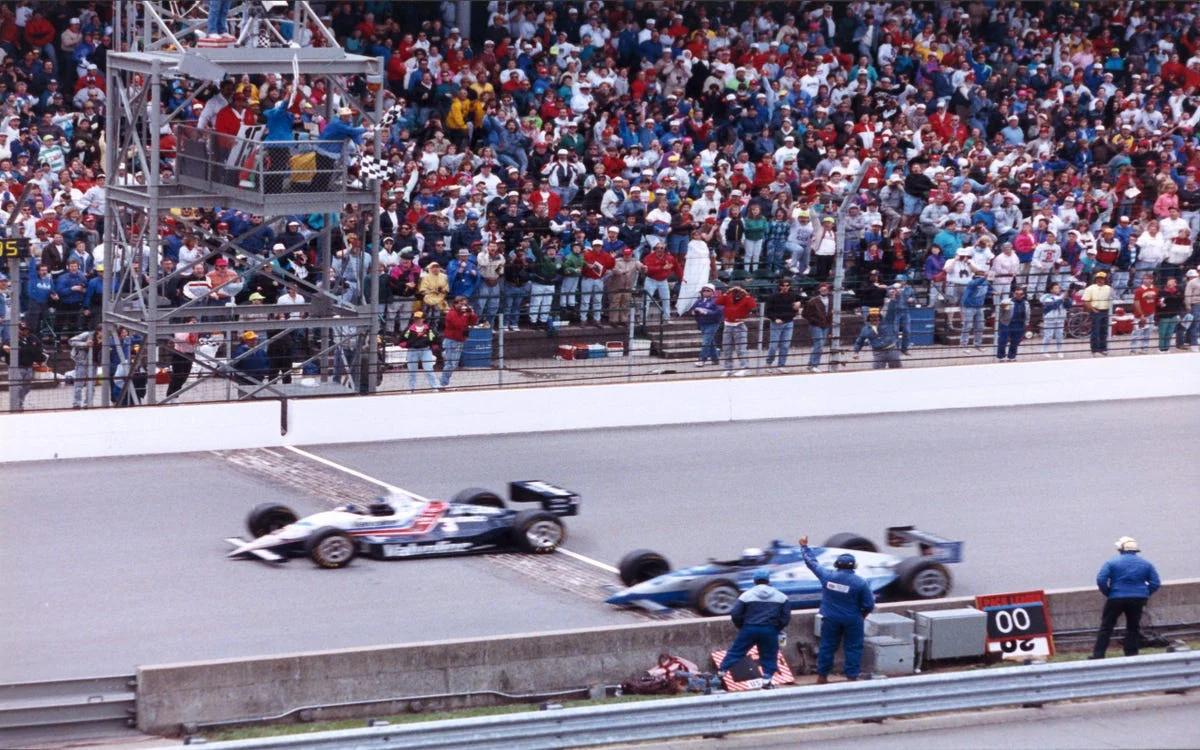
On May 24, 1992, Al Unser Jr. beat Scott Goodyear by 0.043 seconds — still the closest green-flag finish in Indy 500 history.

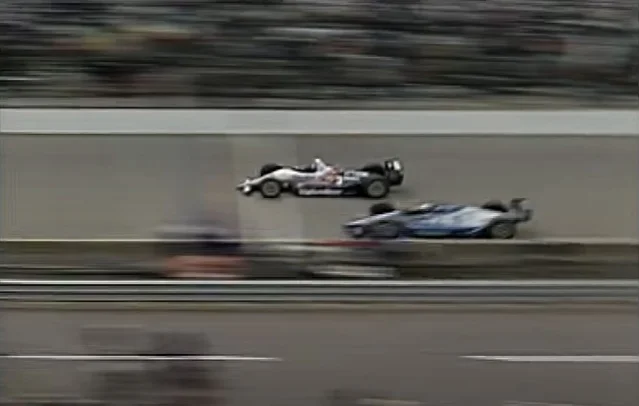
On May 24, 1992, two IndyCars crossed the finish line at the Indianapolis Motor Speedway separated by 0.043 seconds — roughly the time it takes to blink once, slowly. At 220 mph, that translates to about 13.9 feet, or slightly more than half a car length. Thirty-four years later, no green-flag finish in Indianapolis 500 history has come closer. 1
What made May 24 genuinely strange isn't just the number. It's everything that had to go absurdly wrong — and absurdly right — for that number to exist.
The coldest day in Indy history (and it showed)
Race morning opened at 48°F (9°C), with 23 mph wind gusts producing a wind chill near −2°C — the coldest Race Day in Indianapolis 500 history. 2 Racing tires need heat to generate grip. Cold asphalt was not going to cooperate.
The first casualty came before the green flag dropped. Roberto Guerrero, a Colombian-American driver who had just qualified on pole at 232.482 mph — a new track record at the time — took his parade lap and tried to warm his tires on the frigid backstretch. He lost the rear, spun, and hit the inside wall. Guerrero's race was over before it began. The pole-sitter, who had gone faster in qualifying than anyone in Indy history to that point, never started. 2
The cold continued its mischief through the afternoon. Thirteen yellow flags consumed 85 of the 200 laps — 42.5% of the race. Thirteen cars were eliminated in crashes. Mario Andretti crashed and hurt his foot. His son Jeff crashed violently in Turn 2 on lap 115, suffering serious leg injuries. By the end, only 12 of the 33 starters were still running. Four finished on the lead lap.
The man who owned the race — until he didn't
Michael Andretti — son of Mario, brother of Jeff, one of three Andrettis in the race — started sixth in the #1 Newman-Haas Lola-Ford Cosworth XB, a car that was clearly a cut above the rest. He grabbed the lead almost immediately and proceeded to build a cushion that, by any normal measure of racing, made the outcome a foregone conclusion.
Andretti led 160 of 200 laps — 80% of the race. His margin over second place at times approached 30 seconds, nearly half a lap. Al Unser Jr., who would eventually win, later acknowledged the reality: "Michael had us covered all day. The Lola-Ford Cosworths just outrun us bad all day. The best we could do was best in class." 3
Then came lap 189. Eleven laps from the finish, Andretti's fuel pump failed. His car coasted to a stop on the backstretch and was towed to the pits. Classified 13th. The man who had dominated the race more completely than almost any non-winner in Indy history was done. Mario called it the worst day of his life — he himself had crashed, Jeff was hospitalized, and now Michael had given away a race that was his to lose. Which, it turned out, he had.
The man who almost wasn't there
The driver chasing Unser Jr. across the line had almost not made the race at all.
Scott Goodyear, a 32-year-old from Toronto, Canada, had been bumped from the field on Bump Day (May 17) by Ted Prappas — by a margin of exactly 0.089 seconds. 4 Walker Racing then replaced their already-qualified driver Mike Groff with Goodyear. Under Indy rules, a late driver substitution meant Goodyear had to start from the 33rd and last position on the grid. Dead last.
No driver has ever won the Indianapolis 500 from 33rd starting position. Goodyear came within 0.043 seconds of being the first.
The numerical symmetry is almost too neat: Goodyear was bumped out by 0.089 seconds, then lost the race by 0.043 seconds. His entire 1992 Indy experience is a story of almost-but-not-quite margins, both carved in hundredths of a second.
From the back of the grid in his Walker Racing #15 Lola-Chevrolet, Goodyear spent 200 laps working through traffic while the carnage around him thinned the field. When Andretti's car died on lap 189, Goodyear found himself suddenly second — on Unser Jr.'s tail, closing. The final 11 laps became a chase.
0.043 seconds
Unser Jr. admitted he nearly let his guard down. "I almost took it a little too easy off Turn 4," he said afterward, "and Scott got a run on me." 3 He didn't let Goodyear through.
The timing was done by the Dorian Automatic Timing Apparatus — DATA-1 — introduced at Indy in 1990, accurate to 1/10,000 of a second using transponders in each car and antennas buried in the track pavement. 1 The official gap read 0.043 seconds. IMS Radio Network broadcaster Bob Jenkins, doing the call live, caught it in real time: "Little Al wins by just a few tenths of a second. Perhaps the closest finish in the history of the Indianapolis 500! Al Unser Jr. has become the first second-generation driver to win at Indianapolis." 2
There is a footnote to the number. USAC technical director Mike Devin later calculated that the transponder in Unser's Galmer sat in the nose of the car, while Goodyear's transponder sat in the sidepod — a position roughly 10 inches further back from the front axle. Accounting for this placement difference at ~220 mph, Devin announced the corrected margin was approximately 0.0331 seconds. 1 Either way, closer than anything before or since under green.
One more detail: according to contemporary accounts, ABC's television director cut away from the finish line camera at the critical moment, leaving the live broadcast audience without a clean shot of the actual crossing. Only in-car cameras and alternate replay angles captured it properly.
Goodyear was direct about the heartbreak: "It is a disappointment because for the last few laps, I thought this was really a possibility. We just drove flat out. We just didn't have enough to get past him." 3
Little Al and the dynasty
Alfred "Little Al" Unser Jr. (born 1962, Albuquerque, New Mexico) had tried nine times before. His best finish was second in 1989, when he spun while battling Emerson Fittipaldi for the lead with two laps to go. Before the 1992 race, he had confided to ABC broadcaster Paul Page that he feared he might never win. 5
When he crossed the line, Unser Jr. drove to victory lane and said: "Well, you just don't know what Indy means!" 2 He later explained what he meant: "After I won the race, I said, 'Now I can go home and hold my head up at Thanksgiving dinner.'" 6
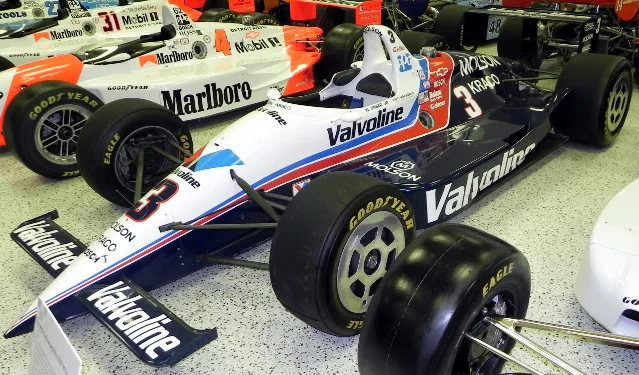
His car — the Galmer G92 chassis, designed primarily for road and street circuits, carrying the aging Chevrolet 265-A engine against the newer Ford-Cosworth XB — was not favored to win on an oval. He led only 25 laps, all of them the ones that mattered. 5
His victory completed something rare in motorsport. Unser Jr. became the first second-generation winner in Indy 500 history — his father Al Unser Sr. had won four times (1970, 1971, 1978, 1987), his uncle Bobby Unser three times (1968, 1975, 1981). The Unser family now holds nine Indy 500 victories, more than any other family in the race's history. 5 Adding a footnote: Al Unser Sr., competing as a late replacement for the injured Nelson Piquet, finished third in the same race his son won — a father-son podium unique in Indy history.
What happened next: two very different stories
Two years later, Unser Jr. won again, this time for Roger Penske driving the Penske PC-23 with the secret Ilmor-Mercedes pushrod engine — a dominant performance that also earned him his second CART championship. ABC named him its Wide World of Sports Athlete of the Year for 1994. 7
Then things went sideways. In 1995, Unser Jr. failed to qualify for Indy with Team Penske. He later described that failure as the trigger for a long descent into alcoholism and the eventual breakup of his marriage. Multiple DUI arrests followed across two decades. His daughter Cody was paralyzed at age 12. His ex-wife Shelley died in 2018. 7 In 2021, he published a candid autobiography, A Checkered Past, co-authored with Jade Gurss. "With the substance abuse disorder that I have, I needed to tell the story," he said. 7 He became a Christian believer in 2019 and was baptized in 2020.
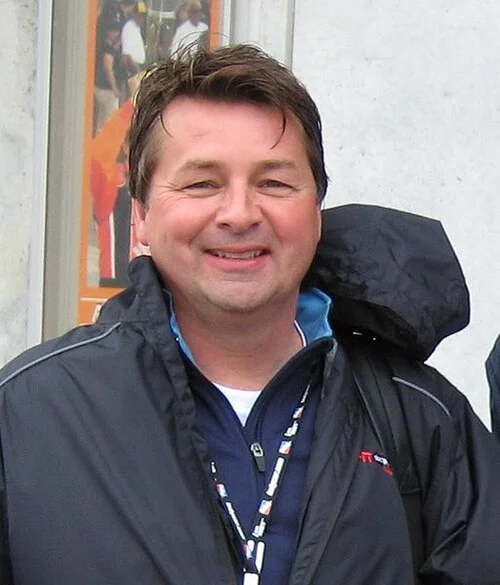
Scott Goodyear had two more near-misses at Indy. In 1995, he led 42 laps but was penalized for passing the pace car on a late restart, dropping him to 14th. In 1997, he led with 10 laps to go before being passed — and the final restart was waved green while caution lights were still on, a controversy that followed the race for years. Three top-two finishes at Indy, zero wins. 4
In 2001, Goodyear broke his back for the second time in a crash at the Indy 500, effectively ending his IndyCar career. He transitioned into broadcasting, becoming a color analyst for ESPN/ABC's IndyCar coverage for 17 seasons. He settled in Carmel, Indiana, a few miles from the track. 8
The 1992 finish never quite left him. "Life still today, honestly doesn't feel complete," he said in 2020. "You look at it every once in a while and you just go, 'I can't believe I didn't get it.'" 6 But there's a flip side: "Since I never won it, second place is still pretty special. Fifty percent of the fan mail that comes in is about that 1992 race." 8
The record, 34 years on
For comparison: the second-closest green-flag Indy 500 finish since 1992 is Ryan Hunter-Reay over Hélio Castroneves by 0.060 seconds in 2014. Two finishes under caution — Dario Franchitti over Scott Dixon by 0.0295 seconds in 2012, and Takuma Sato over Scott Dixon by 0.0577 seconds in 2020 — were technically tighter on the scoreboard, but the field was frozen under yellow. No one raced to the line. 1
Even in motorsport broadly, 0.043 seconds is company you don't often keep. NASCAR's Daytona 500 has produced closer photo-finishes: Denny Hamlin over Martin Truex Jr. by 0.010 seconds in 2016. But those are pack-drafting superspeedway races where a dozen cars can be within a few lengths at any given moment — fundamentally different from an individual pursuit across 500 miles of oval. 9
NESN ranked the 1992 Indy 500 first on its list of the greatest Indianapolis 500 races in history, published in February 2026, with the description: "If you want the Indy 500 distilled into one final lap, it's 1992." 10
Al Unser Jr. put it in plain terms: "I do get asked, of all the races, what was the one that meant the most? And, of course, it's winning the Indy 500. The 1992 race was special because it was the closest finish and one hell of a race between Scott Goodyear and myself." 6
The mirror: In any close competition, the story rarely lives in the final margin — it lives in the decisions made before the last lap. Unser Jr. nearly relaxed off Turn 4. Andretti's dominant car had no mechanical backup plan. Goodyear almost missed qualifying entirely. Any one of those threads pulled differently and the record belongs to someone else. The margin of 0.043 seconds is just where those threads finally stopped.
The next time someone tells you 0.043 seconds is too small a number to matter: at 220 mph, it's 13.9 feet. It's a half car-length. It's everything.
Cover image: Al Unser Jr.'s #3 Valvoline Galmer at the 1992 Indianapolis 500, via Autoweek
References
- 1Indianapolis 500 Closest Finishes
- 21992 Indianapolis 500
- 3Top 10 Indy 500s, No. 8
- 4Scott Goodyear
- 5Al Unser Jr.
- 6Unser, Goodyear Produced Epic Duel for the Ages
- 7Al Unser Jr. Hopes to Inspire With New Biography
- 8Fast times: Former Indy 500 driver, TV analyst Scott Goodyear
- 9Closest finishes in Daytona 500 history
- 10Best Indianapolis 500 Races of All Time
Add more perspectives or context around this Drop.